The Distribution of Art
‘The definition of artistic activity occurs, first of all, in the field of distribution.’
– Marcel Broodthaers
Boris Groys once said in his essay Art beyond Spectatorship, “The artist produced an artwork and brought it to the eyes of the spectator. The spectator looked at this artwork and formed his or her aesthetic judgment of it.” The gallery was usually the place where art was displayed and seen. Artists would produce the artwork and bring it to the gallery, and spectators would go to a gallery to see and evaluate the artwork. Various paintings and sculptures from a wide range of time periods and styles were hung on walls and placed on plinths. Galleries were the place for the evaluation and distribution of art and culture. However, the gallery system posted a problem as the artist was always under the value judgment of the spectator. Their works would always be under the spectator’s comparative and evaluative gaze, which they cannot escape from, and it was ultimately the spectator and not the artist who had the power to control the process of art production and consumption. Therefore the artist was not free. It was the problem that stuck with modern art.
Avant-garde artists in the mid 60s and 70s tried bring a new wave to art history to free the artist from the spectator’s gaze and the bureaucratic gallery system. There was a breakthrough to bring art outside of the gallery, to rebel against the gallery system, the commercial art market, to elitism, and the conventions of both art and society. They explored alternative ways for the distribution of art by changing the time and place of where art happens. The dematerialization of the art-object also occurred around this time, which led to the raise of conceptual art, a movement that aims to produce no actual “pieces” of work, but instead focuses on the ideas as the work. Works also ceased to be an object and tended more to become an event, an event that included the spectator as a part of the work as the piece often require participation or an act by the spectator, so therefore they lose their absolute position in the work. They began exploring making art using network culture.
Artists began to experiment with publishing, as music and film producers, as entrepreneurs trying to “sell” their artwork to the public bypassing the gallery system. Lucy Lippard wrote, “Since novelty was the fuel for the conventional art market, Conceptual artists gloried in speeding past cumbersome established process of museum-sponsored exhibitions and catelogues by means of mail art, rapidly edited and published books of art, and other small-is-better strategies.” Mail art were small-scale works, usually a poem, drawings or a collage sent using the postal service between artists rather than exhibiting or selling through commercial channels. Dan Graham’s work Figurative (1965; published March 1968) is a cash-register receipt printed in Harper’s Bazaar as an advertisement, which the editor memorably placed between the ads for Tampax and for a padded, torpedo-shaped bra. The work itself is a list of random numbers that appears to advertise nothing. Yet next to conventional ads, the monetary receipt format exposes the fashion magazine as capitalist propaganda ultimately concerned with the bottom line. Artists began to work in the extension of the process of production. Quoting Fiona Banner, an artist who works with self publication and has published her own work The Vanity Press herself. She said, “The Vanity Press came about when I realised that books and publishing could be up to me. I didn’t want to be reliant on the gallery system and I enjoy the democratic nature of self-publishing.”
An example of artists making use of network culture is Fluxus. Fluxus is an international and interdisciplinary group of artists, composers, designers and poets that took shape in the 1950s with members spanning from North America, Europe and Asia and some are still working today. Intentionally to be uncategorizable, the founder of Fluxus, George Maciunas said that the purpose of Fluxus was to ‘promote a revolutionary flood and tide in art, promote living art, anti-art’. He wrote in the first publication of Fluxus magazine, the infamous Fluxus manifesto, “Purge the world of bourgeois sickness, ‘intellectual,’ professional & commercialized culture, PURGE the world of dead art, imitation, artificial art, abstract art, illusionistic art, mathematical art, — PURGE THE WORLD OF ‘EUROPANISM’!” The most persistent goal of Fluxus artists was to bring a new wave into the history of art, to challenge the status of the elitist gallery system by making works that are not accountable in the gallery, and finally, to destroy any boundary between art and life, and to underscore the revolutionary mode of thinking about the practice and process of art. Major participating artists in Fluxus include Joseph Beuys, George Maciunas, Yoko Ono, Nam June Paik and Wolf Vostell.
One of the works under the style of Fluxus is The Total Art Matchbox (1966), a piece by Ben Vautier. It is a box of matches with "directions" printed on the cover stating, "USE THESE MATCHES TO DESTROY ALL ART - MUSEUMS ART LIBRARY'S - READY-MADES - POP-ART AND AS I BEN SIGNED EVERYTHING WORK OF ART - BURN - ANYTHING - KEEP LAST MATCH FOR THIS MATCH -" This piece literally proclaims the Fluxus belief in anti-art and is one of many boxes manufactured. Often Fluxus artists would produce a large number of identical pieces to deliberately devalue the object. It can be assumed that manyof these boxes were burned as per the instructions on the cover, and the involvement of the viewer destroying pieces of work becomes part of the work themselves, completing the piece.
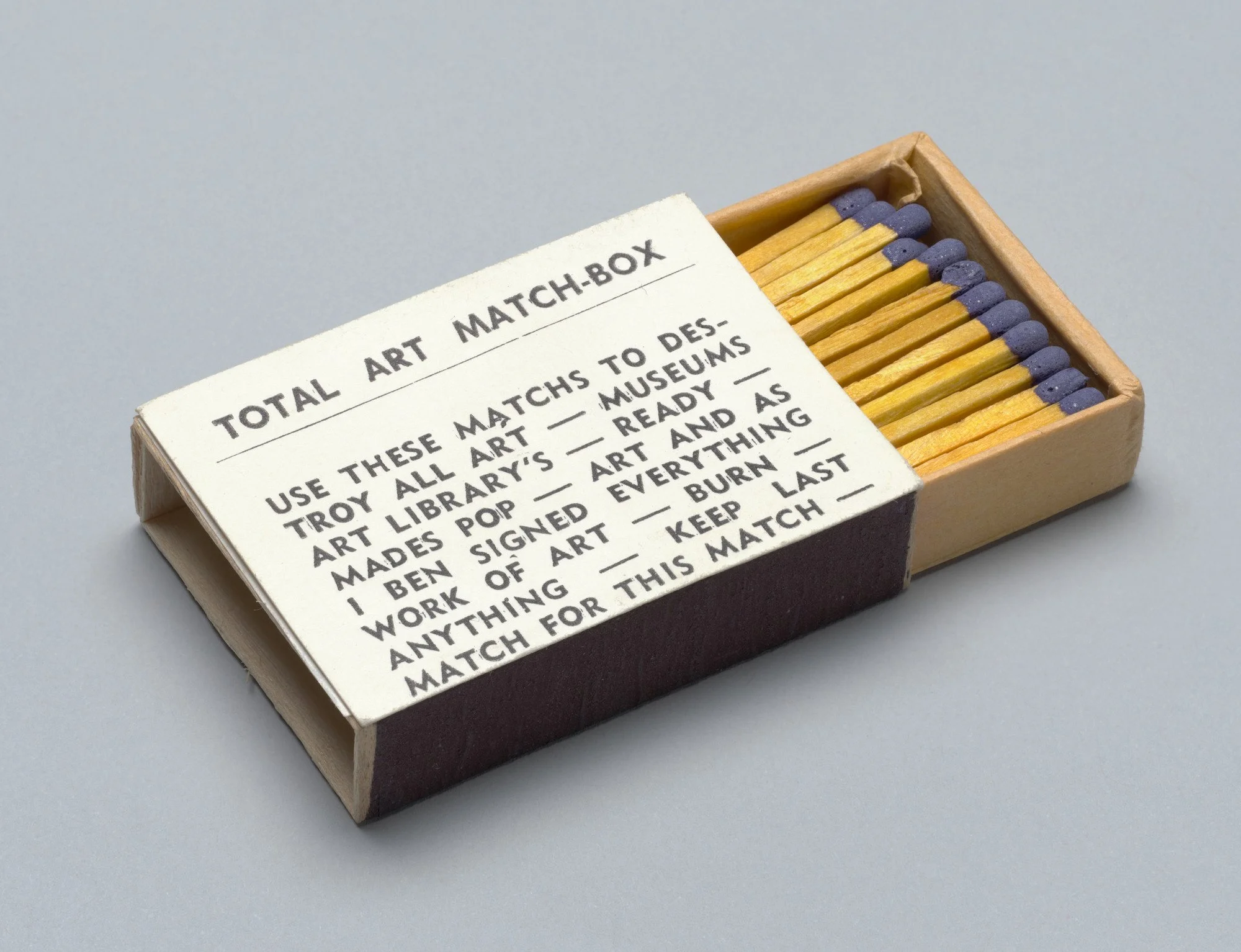
Ben Vautier , The Total Art Matchbox (1966)
The Xerox Book was organized and published by Seth Siegelaub in 1968. The project involved a range of artists associated with Siegelaub’s curatorial practice and utilizing unconventional modes of exhibition, this book marks the ongoing attempt by Siegelaub to show work outside of the gallery setting, and his first time showing an exhibition in book form. Seigelaub once said to Hans Obrist, “This project evolved in the same way as most of my projects, in collaboration with the artists I worked with. We would sit around discussing the different ways and possibilities to show art, different contexts and environments in which art could be shown, indoors, outdoors, books, etc.” We can see that the original intention of the Xerox book was to be seen outside of the gallery setting, to explore different modes of artistic distribution, and the book itself function as a cheaply mass-produced artist’s publication without much economic value. The participating artists are Carl Andre, Robert Barry, Douglas Huebler, Joseph Kosuth, Sol LeWitt, Robert Morris, and Lawrence Weiner. Siegelaub asked each artist in the exhibition to create 25 pages of work that responded to the photocopy format. Though the Xerox process proved financially unfeasible—the works ultimately being reproduced through the more conventional printing press—the book continued to be referred to as “The Xerox Book,” preserving its association with the then-new photocopy technology.
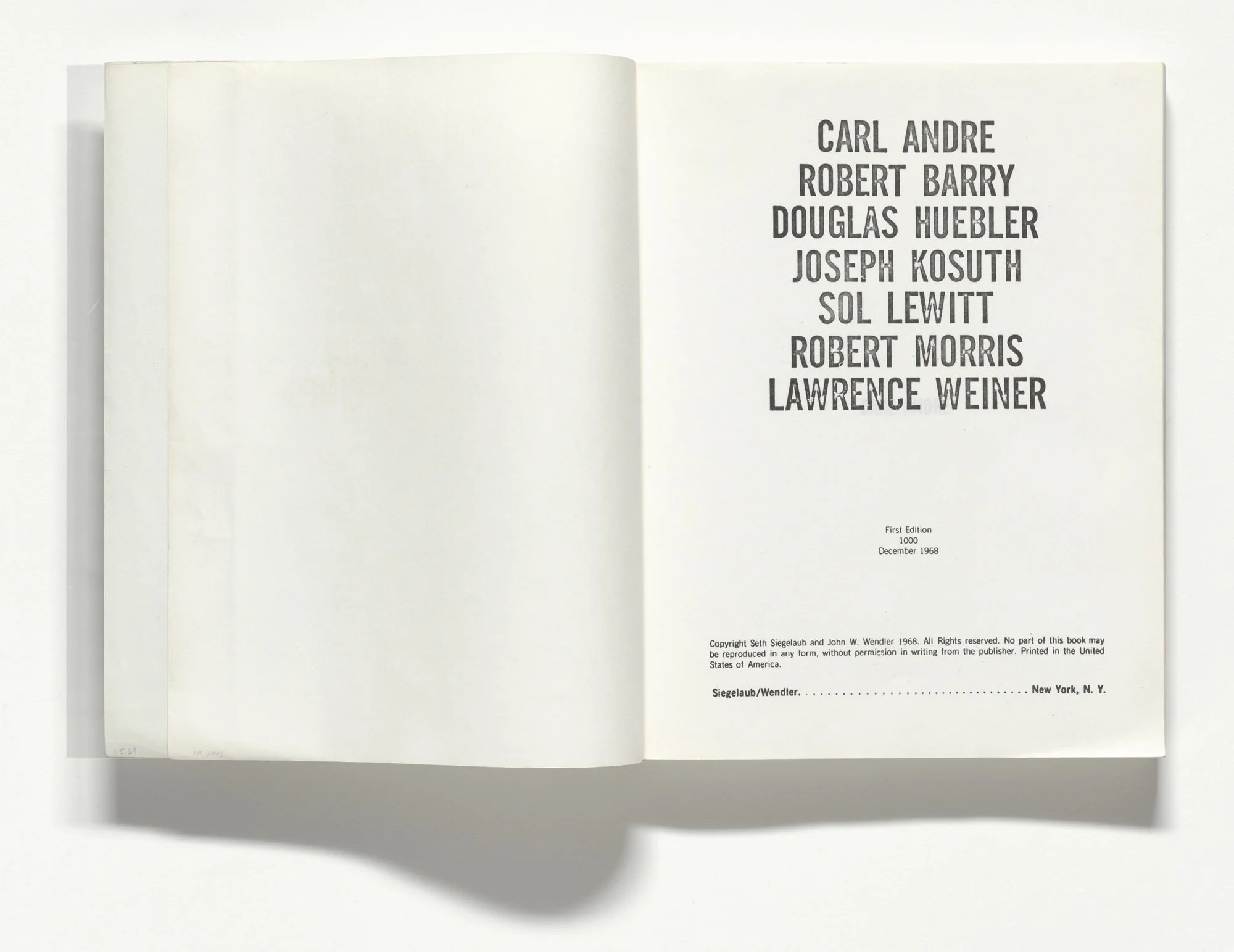
Seth Siegelaub, Carl Andre, Robert Barry, Douglas Huebler, Joseph Kosuth, Sol LeWitt, Robert Morris, Lawrence Weiner, The Xerox Book (1968)
The Xerox book project ultimately failed. Firstly it failed to be produced in the original way that was planned; it was unable to fulfil its original intention of being a photocopier book due to the production costs at that time being too high. Second, the cultural aspect was too profound to ignore despite it originally aiming to challenge the status of being a valuable art object. The fact that these artists collaborated to make the work had added so much value to the work that the materiality, the “made” of the work seemed secondary to contributing to its value in the art market. Works like the Xerox book made people realise that there are two aspects, two distinct economies that contribute to the work’s value. First, there is the economic, materiality value of the work. The cost of production, and there is the symbolic value of the work that disregards the first factor. The fact that these artists collaborated to produce the work has added a cultural, invisible value that cannot be measured. This adds to the struggle and undermines the whole idea of conceptual art which aims to be lightweight, ephemeral and unpretentious.
“The new dematerialized art provides a way of getting the power structure out of New York and is spreading it around to wherever an artist feels like being at the time. Much art now is transported by the artist, or in the artist themselves, rather than by watered-down, belated circulating exhibitions or by existing information networks.” Method of distribution had since become part of the medium of the artwork since artists can now choose how they would show their work and where. Conceptual art happenings had allowed artists to evade the gallery system and venture into the public sphere, to produce work and engage with audience directly. It has empowered artists since they no longer work under the eyes of the gallery curator since art is now self-curated and organised. Opened up new channels and roles for the artist. Art no longer has to be seen in a gallery or in a constitutional space to be considered as art. The boundaries of spaces where art can happen had been broken down by the artists. It also frees and opens up opportunities for young artists as they often have a difficult time getting gallery representation.
Technology has progressed a lot since the 1960s, and artists now have even more advanced networks than they used to 60 years ago. The rise of the World Wide Web and the popularisation of the internet has led to a whole new realm of art, the net art. Net art is art that is made and shown on the internet. It is a process of making art using a computer in some form or other, whether to download imagery that is then exhibited online, or to build programs that create the artwork. Net art emerged in the 1990s when artists found that the internet was a useful tool to promote their art uninhibited by political, social or cultural constraints. For this reason it has been held as subversive, deftly transcending geographical and cultural boundaries and defiantly targeting nepotism, materialism and aesthetic conformity. Sites like Tumblr and YouTube have become forums for art, enabling artists to exhibit their work on a virtual space without the endorsement of an institution. Pioneers of net art include Tilman Baumgarten, Jodi and Vuc Cosik.
The internet is a virtual space for data sharing and downloading. It acts as a digital gallery space but it does not exist physically. It also acts as a space for archiving. The creative process of the artist is now closely linked to the internet. The working process of the artist is documentable and sharable thanks to blogging sites, and anyone can access the artist’s records if they wish to with an Internet connection. Rather than the gaze of the spectator in a gallery, there is now an even more all-knowing presence, the gaze of the Internet, the digital algorithmic eye that surveys every activity. The gaze of the traditional spectator is replaced by the gaze of the internet, by the mass of documentation – it is a gaze no one can escape from. Not the artist, not the spectator, and not institutions.
Bibliography
Tate. (n.d.). Fluxus – Art Term | Tate. [online] Available at: http://www.tate.org.uk/art/art-terms/f/fluxus [Accessed 6 Jan. 2018].
Groys, B. (2014). Art beyond Spectatorship. [online] BOZAR. Available at: https://www.bozar.be/en/activities/2455-boris-groys [Accessed 2 Jan. 2018].
Tate. (n.d.). Mail art – Art Term | Tate. [online] Available at: http://www.tate.org.uk/art/art-terms/m/mail-art [Accessed 23 Dec. 2017].
Kedmey, K. (2017). How the Fluxus Movement Took Art out of Museums and Galleries. [online] Artsy. Available at: https://www.artsy.net/article/artsy-editorial-fluxus-movement-art-museums-galleries [Accessed 2 Jan. 2018].
Moma.org. (n.d.). MoMA.org | Interactives | Exhibitions | "This is the way your leverage lies": The Seth Siegelaub Papers as Institutional Critique. [online] Available at: https://www.moma.org/interactives/exhibitions/2013/siegelaub/ [Accessed 27 Dec. 2017].
Lippard, L. (2007). Six years: The dematerialisation of the art object from 1966 to 1972. Berkeley: Univ. of California Press
Louise, D. (2016). A Q&A with... Fiona Banner, artist - a-n The Artists Information Company. [online] a-n The Artists Information Company. Available at: https://www.a-n.co.uk/news/a-qa-with-fiona-banner-artist-and-font-designer [Accessed 28 Dec. 2017].
Phillpot, C. (n.d.). Manifesto I. [online] George Maciunas Foundation Inc. Available at: http://georgemaciunas.com/about/cv/manifesto-i/ [Accessed 4 Jan. 2018].
Images
Harvard Art Museum (n.d.). Total Art Match-Box. [image] Available at: https://www.harvardartmuseums.org/art/10961 [Accessed 5 Jan. 2018].